Overcoming a Firefighter's Trauma
A REMAP Case Study
By Steve B. Reed, LPC, LMSW, LMFT Copyright 2007
For an introduction to this article and to Steve B. Reed
written by Martha Magenta © 2007, for infoholix.net

Flames were rapidly engulfing the house. Yet a last minute, gut instinct by the lead firefighter (who we shall call Robert) led him to make one final sweep for any remaining occupants. As he and one of his rookie firefighters reentered the home, things began to collapse. He is still not sure what fell on him but he thinks it was a bookcase. Trapped, pinned under the weight and nearly surrounded by flames, this courageous man remained calm. Robert was able to think clearly. He could clearly see that his rookie firefighter was beginning to panic, so he ordered him to go get help from some of the more seasoned firefighters.
For most people, being trapped in a burning house would be a horrifying experience. However, for this brave soul that was just part of a day’s work. His training had prepared him to deal with such things. What had traumatized him was something far worse. It was something to which no compassionate person could be indifferent. It was something that he could not get out of his mind. He relived it everyday.
His real-life nightmare started with the sound of somebody screaming. As he looked up through the visor of his breathing apparatus, he could barely make out the image of a small, frightened child--perhaps four years old. He motioned for her to come toward him but she seemed paralyzed with fear. What he remembered most was the look in her eyes as she caught fire. Helpless to prevent it, he could do nothing but watch as she burned to death.
When he arrived for his first appointment with me, it did not take long to see that his life had been devastated by this event. His difficulty in coping with the traumatic stress had led to a divorce some months earlier. He was unable to work and had gone out on short-term disability. His quality of life had totally disappeared.
Psychological testing revealed that he was severely depressed (even after being on antidepressants for many months). He was also experiencing both Generalized Anxiety Disorder (GAD) and a high degree of current anxiety about his trauma, known as "state anxiety". ("State anxiety" measures a person's current anxiety level and is separate from "trait anxiety", a measure of their natural tendency toward anxiety.) In fact, his current state anxiety ranked in the 100th percentile (the highest) for men his age. He scored very high on the Impact of Event Scale (a measure of the impact of traumatic events). He also met the clinical criteria for Post Traumatic Stress Disorder.
Seeing little girls in public--about the age of the victim--triggered nightmares, sleep disturbance, intrusive memories of the trauma and flashbacks. He lost his ability to enjoy playing with his own children, who were relatively the same age as the victim. He was not able to tell the story of the tragedy without starting to cry and he reported that, in general, his attitude and mood were far worse than usual. When asked how badly the experience bothered him on a scale of 0 to 10 (where 10 is the worst), he said it was definitely a 10. In brief, his life had truly become a nightmare.
After discussing treatment options, he decided that the REMAP process (a treatment method that utilizes cognitive, behavioral and psycho-sensory interventions to desensitize trauma) was right for him. He was also willing to participate in my on-going research regarding the effectiveness of REMAP treatment on trauma sufferers. Part of that research, in addition to psychological testing, is to measure the physiological effect of thinking about a traumatic event on the electrical activity of the heart both before and after treatment. Through measuring the variability in time between heartbeats, we are able to reveal important information about the nervous system, especially whether the body is in a fight-or-flight reflex. This information can then be compared to assess change.
As I would have expected, his heart activity showed a greater stress response when thinking about the trauma than when thinking about neutral thoughts. His heart rate increased and measurements of the balance between his sympathetic and parasympathetic nervous systems worsened. Every time he thought about the little girl's tragic death, his body was reacting as if he was there.
Robert could not understand why he continued to be so disturbed by this event. A psychiatrist was treating him in his community and he had been taking antidepressants for nearly a year. However, nothing was helping.
I explained to Robert that when people experience traumatic events that it affects a part of the brain that is only marginally accessible by language. That part of the brain is known as the mid-brain or limbic system. The limbic system developed prior to the thinking brain (or cortex). Since it is a more primitive structure, it is not able to think in the same way as the cortex. However, it can be conditioned by painful experiences to react with an alarm reflex known as the fight-or-flight response. After a traumatic event, a small almond-shaped part of the mid-brain called the amygdala (Greek for almond) encodes all of the information about the trauma. Then, any reminder of the painful experiences triggers an instant response from the amygdala that sets off the body's fight-or-flight reaction. The heart rate increases, blood vessels constrict and adrenalin is released into the body. There is dilation of bronchi, muscles tighten and the sweat glands become more active. We become ready to run for our life or fight for our life even if there is no clear or present danger. As I said, the limbic system cannot think in the same way as the cortex. It cannot make a distinction between a real threat and a reminder of a previous threat. Therefore, it fires up the alarm. If this reaction is intense enough, then even the thinking brain begins to shutdown. This contributes to PTSD, Panic Attacks and Phobias developing.
Medicine alone does not resolve the problem. At best, it only numbs our reactions. Traditional talk therapy can be ineffective as well. Talk therapy targets the cortex (thinking brain). The problem resides in the mid-brain where language only has a minimal reach. I explained to Robert that this is why he had continued to suffer from the effects of his trauma. I also explained that by combining some of the best behavioral and cognitive interventions with psycho-sensory interventions (that researchers at Harvard found has a direct influence on the limbic system) that we could calm that part of his brain.
The REMAP process works by combining a behavioral method known as Systematic Desensitization (Wolpe, 1958), cognitive interventions and psycho-sensory interventions drawn from acupressure that lead to a profound relaxation response. It seems that we are unable to be profoundly relaxed and intensely stressed at the same moment in time. These experiences are mutually exclusive. When we create a profound relaxation response (at a deep brain level) during thoughts about a traumatic event, then a dramatic shift occurs. The brain learns a new response to the painful thoughts—relaxation. When relaxation and comfort become linked with the traumatic memories, then the emotional pain melts away and it is replaced by a natural objectivity. The amygdala has then learned that everything is all right and that it no longer needs to fire up the alarm. With this part of the brain recalibrated to a neutral set point, previous reminders of the trauma no longer evoke a reaction. I explained to Robert that the REMAP process is a method that could help in this way.
Research at prestigious institutions such as Harvard Medical School, Yale School of Medicine, UC Irvine, Medical University of Graz, in Austria and St. Saves Hospital, Athens are showing the effectiveness of acupressure/acupuncture for relieving anxiety and stress. A study using fMRI brain scans at Harvard showed that key acupuncture points caused a calming of the limbic system within seconds. This direct link to the amygdala is what enables the REMAP process to produce such a rapid and profound calming effect.
The REMAP pilot study showed that the treatment was effective in calming the sympathetic nervous system (think anxiety response) and enhancing the functioning of the parasympathetic nervous system (think relaxation response). The REMAP process combines psychological methods for easing emotional pain with the physiological calming effects of precise acupressure protocols. The combination enhances the overall treatment effect. This makes is an effective anxiety treatment, PTSD treatment and Phobia therapy (such as a therapy for the fear of driving).
Robert asked about how long the treatment might take. I said that although everyone can respond differently, the REMAP pilot study with trauma victims showed that we could successfully treat a single traumatic incident in one to three sessions. I advised Robert that the number of sessions required per trauma could be more for people who could not easily access their feelings and memories. Fortunately, Robert could connect with his experience of the traumatic event easily and his treatment only required three REMAP sessions (totaling 94 minutes of treatment). This was slightly longer than the average number of sessions and treatment time for a single traumatic event in the REMAP pilot study (two sessions totaling 87 minutes of treatment).
In all, I met with Robert six times. The first time we met, I did a thorough assessment so that we could focus his treatment in the best way. In our second appointment, we measured his physiological response to the traumatic memory and had our first REMAP session. Our third meeting was devoted to a completely unrelated issue regarding a dating relationship in which I provided some counseling and guidance. In our third and fourth meetings, we had our final two REMAP sessions. Our last meeting was a reassessment of his current response to the trauma event. That assessment showed that his trauma had been successfully resolved.
The results of treatment were significant for Robert. Below I have itemized the details of his condition prior to treatment verses after treatment.
- Subjective Report of Symptoms:
a) Physical Symptoms of Emotional Distress
Before REMAP Treatment | After REMAP Treatment |
| Flashbacks—Triggered by seeing 4 year old girls | No Flashbacks—Seeing 4 year old girls felt comfortable and normal—no reaction |
| Frequent Nightmares | No more nightmares |
| Sleep disturbance | His sleep quality was much better--normal |
| Intrusive thoughts of the incident | No intrusive thoughts about it |
| Unable to tell the story of the event without crying | Now able to tell the story to others without crying and feels calm and more objective |
| Loss of joy playing with his children | Enjoys playing with his children again |
| His attitude and mood were worse than usual | His general attitude and mood seem normal when thinking about this event |
| Shoulders and arms—tense when thinking of the trauma | Relaxed |
| Hands shaking | Hands steady |
| Leg tension | Legs relaxed |
| Mouth dry | Normal |
| Warm or hot feeling | Temperature O.K. |
| Experiencing an adrenalin rush | Calm feeling |
b) Subjective Units of Distress Scale
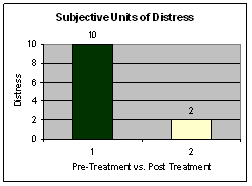
On this scale, 10 is equal to the worst possible distress and zero equals none at all. His scale dropped from 10 to two. That is an 80% improvement in his subjective distress level.
- Psychological Assessments:
a) Inventory of Depressive Symptomatology— self-report30 (IDS-sr)
Because of REMAP treatment, Robert's level of depression dropped by 24%. Before treatment, he scored severely depressed. After treatment, his level of depression dropped to moderate.
b) Generalized Anxiety Disorder-7 Questions (GAD-7)
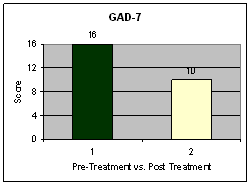
Generalized anxiety disorder (GAD) scores dropped by 37% after treatment. The score after REMAP treatment was below the threshold for GAD. Thus, Robert was free of generalized anxiety.

c) State-Trait Anxiety Inventor—state scale (STAI-s)
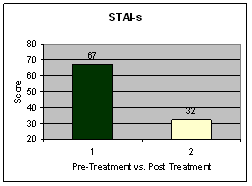
The STAI is the most widely used measure of anxiety in research. After treatment with the REMAP process, Robert's raw score dropped by 74%. His score prior to treatment put him in the 100th percentile (highest category) for men his age. After treatment, his score was in the 39th percentile. This is below the average score for his age group.
d) Impact of Event Scale—Revised (IES-r)
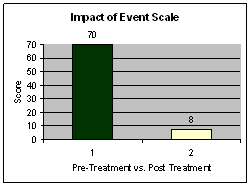
Robert's score on the Impact of Event Scale--revised ( IES-r) improved by 88% after REMAP treatment. This is a strong indication of trauma resolution.
- Physical Measures:
Assessing Changes in Heart Activity through Spectral Analysis of the Electro-cardiogram:
We analyzed Robert's heart activity for physical signs of stress utilizing the Medicore SA 3000 Heart Rate Variability Analysis System. Three measures revealed noteworthy change. The first measure is heart rate. When under stress the heart rate increases. Before treatment Robert’s resting heart rate, while thinking about neutral thoughts, was 98 beats per minute (bpm). This is unusually high. However, when he thought about his trauma his heart rate increased to 104 (bpm)—more stress. After treatment, his resting heart rate was 98 (bpm) while thinking about neutral thoughts. Then, when he thought of his traumatic event, his heart rate slowed to 95.5 beats per minute—more relaxed thinking about the previous trauma than thinking about neutral thoughts.
The next measure is the Low Frequency/High Frequency Ratio (LF/HF ratio). Low frequency electrical activity of the heart corresponds to sympathetic nervous system activity (again, think fight-or-flight reflex). High frequency activity corresponds to para-sympathetic nervous system activity (think calming and relaxing influence). The higher the ratio, the more stress is present. The lower the ratio, the more the nervous system is calm. In the above example, prior to treatment Robert was very calm when thinking about neutral thoughts. He may have been having a generally calm day to start with. However, when he thought of his trauma his sympathetic nervous system took control and increased over 14 times. After treatment, the LF/HF ratio was nearly identical. This shows that there was no change in physical stress between thinking about neutral thoughts and thinking about his traumatic event after treatment. If a person feels no more distress when thinking about a trauma than when thinking about neutral thoughts, then it is a good sign that they are no longer bothered by it.
The final measure that we will look at is the RMS-SD. It indicates the degree that the para-sympathetic nervous system (calming influence) is functioning at a given time. Although this measure will vary from day-to-day depending on current stress, higher scores indicate less stress. In Robert's case, his RMS-SD score dropped from 17.48 (thinking about neutral thoughts) to 14.19 (thinking about his trauma) before treatment. This means that the ability of his para-sympathetic nervous system to calm him was not working as well and that his stress level increased. However, after treatment his neutral thought score was 9.06 (on this day he was a little more stressed in general than in the previous test) but his score improved to 10.77 when thinking about his trauma. This is another indication that he was calmer and less stressed thinking about his trauma than even neutral thoughts. This is good physical evidence that he is no longer troubled by his traumatic experience.
Changes in Heart Rate Variability Measures:
Before Treatment | After Treatment | |
Neutral Thoughts vs. Traumatic memory | Neutral Thoughts vs. Trauma | |
| Heart Rate (beats per minute) | 98 vs. 104 | 98 vs. 95.5 |
| Low Frequency/High Frequency Ratio—normalized units (LF/HF ratio) | 0.73 vs. 10.38 | 2.16 vs. 2.22 |
| Root Means Squared of the Standard Deviation (RMS-SD) in milliseconds | 17.48 vs. 14.19 | 9.06 vs. 10.77 |
- Behavioral Change:
Before REMAP Treatment | After REMAP Treatment |
| On short-term disability—unable to work due to PTSD | He successfully returned to work after our last session. |
I met with Robert weekly for six weeks. Three of those sessions involved treatment with the REMAP process totaling 94 minutes of actual REMAP therapy. The other three sessions involved assessments and consultation regarding an issue unrelated to his trauma. Because of his treatment, all of his subjective reports, psychological assessments and physical measures changed in positive ways. His behavior also changed for the better. He was able to feel dramatic relief and resume a normal life.
A follow-up telephone call took place seven weeks after our last meeting. Robert was still doing well. He was feeling fine regarding the traumatic event that we had treated and he continued to be able to work.


