
Quick REMAP is comprised of seven protocols, including the:
- 4-point protocol
- 8-point protocol
- 12-point protocol
- 16-point protocol
- Primary Point Protocol
- Tonification Point Protocol and
- Sedation Point Protocol
All of these rapid relief protocols (except for the 16 point protocol) are available in the
- Quick REMAP Professional Handbook (90 pages) and in the
- Quick REMAP Self-Help Book
This free 30-page manual (which is a portion of the two books above) only covers the 4-point protocol. To get all of the Quick REMAP protocols and additional valuable information on working with them, please order the Quick REMAP Professional Handbook (for licensed professionals) or the Quick REMAP Self-Help Book (for anyone wanting to ease emotional distress). ORDER at https://psychotherapy-center.com/self-help-products/
You can also learn Quick REMAP from the Quick REMAP Seminar on DVD.
Getting Prepared to Work with Quick REMAP
Preparation is the secret to success in many endeavors. It is particularly true when you work with the REMAP process. Before you begin working with the Quick REMAP steps, there are important things that you will need to know and to do. First, you need to understand why we will be working with the particular acupressure points that I have chosen for this brief treatment. If you understand why they are so effective, then it will be easier for you to rely on them when you need them most. Second, you need to be able to find the exact locations of these acupoints28 in order to get the maximum relief. Third, you will need to choose a specific distressing event from which you would like to find relief. Finally, you must learn how to tune-in to that event. By doing so, you will get the most benefit from this method. Let us begin with why the Quick REMAP rapid relief points are so important.
Facts about the Rapid Relief Acupressure Points
You will only need to work with four acupressure points in the Quick REMAP (4-point) Rapid Relief Protocol. However, these four points are very potent and very capable of easing intense emotional distress. This technique is especially good with such overwhelming experiences as panic attacks, phobias, and traumas. It is also excellent for less intense stressful events.
Research studies have proven the powerful effect that these acupoints produce in the brain, the nervous system, in heart activity and in our psychological outlook. Some of the studies were from prestigious institutions including Harvard Medical School and the Yale University School of Medicine.
The first two rapid relief points have been the subject of research studies at Harvard Medical School. They are the fourth treatment point on the Large Intestine meridian and the 36thtreatment point on the Stomach meridian.
In traditional Chinese medicine, there are pathways of acupressure points that serve each major organ in the body. These pathways are called meridians. Each pathway is named for the organ it serves and has a varying number of points that range from nine to sixty-seven.
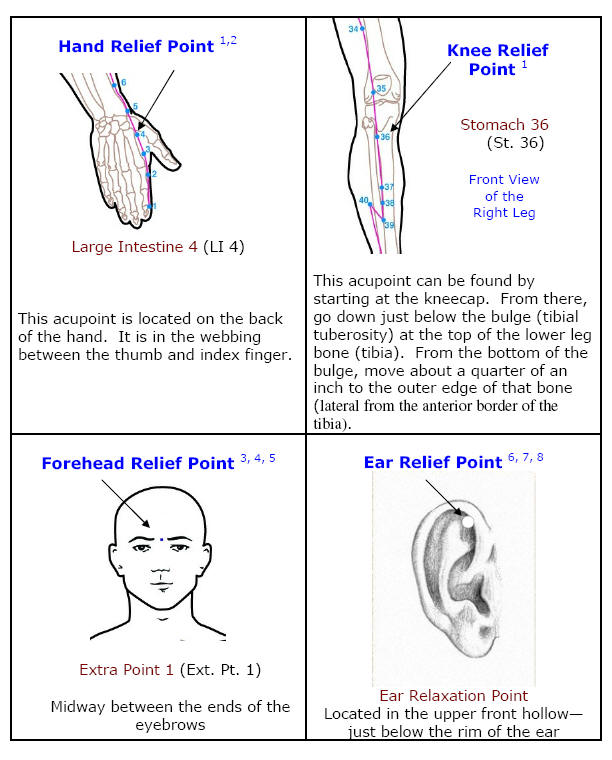
These two points each have a Chinese name also. Large Intestine 4 is “Hegu” and Stomach 36 is “Zu San Li”. To keep it simple, we can refer to these as the Quick REMAP “hand relief point” and “knee relief point”.
At Harvard, researchers use a powerful device to look deep inside the brain. It is a functional Magnetic Resonance Imaging machine (fMRI). With it, they are able to see what happens in the brain when an acupressure point is activated.
Activating these two relief points produces impressive changes in several key brain areas. The two areas of the brain most associated with the “fight or flight reflex” (the amygdala and hippocampus) became calm (deactivated) within seconds of stimulating these acupoints. Heart rate also slows.1, 2 Just as you might type in a code to turn off the alarm system in your house, activating these acupoints turns off the alarm center in your brain.
This is a very useful thing. It is especially useful in cases such as a PTSD sufferer who hears a car backfire and thinks he is being shot at by a gun. If your “fight or flight reflex” becomes triggered when there is no clear or present danger, then having a way to turn off the alarm and retrain the brain not to sound a false alarm would be wonderful. That is exactly what these two Quick REMAP rapid relief point do.
In traditional Chinese medicine, Stomach 36 is considered stronger than the other points on that meridian.9 In modern studies on mice, activating this point is shown to regulate the immune system, reduce inflammation and produce an anti-arthritic effect.10
The third relief point that we will work with is the Quick REMAP Forehead Relief Point. The Chinese call this point “extra point number 1″ or “Yintang”. Research shows that this acupoint calms brainwave activity to levels close to what people experience during anesthesia.3, 4, 5 If it has that great of a calming effect, just think what it can do as an antidote for intense stress.
The last of our four relief points is an ear acupoint. It is called the “ear relaxation point” (for our purpose it is the Quick REMAP Ear Relief Point). Research shows that it lives up to its name. Research at Yale University School of Medicine shows that this acupoint produces positive changes in psychological indicators for anxiety, depression and stress.6, 7, 8 It is powerful enough to produce these changes in elderly patients with broken hips while being transported to the emergency room.
You can see that the points that I base the Quick REMAP (4-point) rapid relief intervention on are capable of creating very powerful changes in both body and mind. These are professional strength rapid relief points that are well suited for distressing problems both great and small. Next, we need to find the exact location of each acupoint.
Finding the Location of the Quick REMAP Rapid Relief Points
Below you will find drawings from the REMAP Acupressure Charts22 that show the locations of the four rapid relief points that we use in the Quick REMAP (4-point) Rapid Relief Protocol. These are the Hand Relief Point, Knee Relief Point, Forehead Relief Point and the Ear Relief Point.
Treat the hand, knee and ear relief points on both sides of the body.
Copyright 2007 Steve B. Reed, LPC, LMSW, LMFT www.remap.net
Studies Prove Acupressure’s Point
Research at prestigious institutions (including Harvard Medical School & Brigham and Woman’s Hospital, Yale School of Medicine, UC Irvine, Medical University of Graz, in Austria, and St. Savas Hospital, Athens, Greece) are showing the effectiveness of acupressure/acupuncture for relieving anxiety and stress. Studies using fMRI show a reduction of blood flow to the amygdala (the brain’s alarm center) that corresponds to an easing of emotional and physical pain. (1,2) The same research found that acupuncture increased serotonin, a mood-regulating chemical in the brain. Studies using EEG brain wave activity and auditory responsiveness to measure states of consciousness found that acupressure could produce similarities in consciousness to people who are under anesthesia. (3,4,5) Other research is finding that acupressure produces positive changes in psychological indicators for anxiety, depression and stress. (6,7,8) Additional studies not listed here also show significant changes in the electrical activity of the heart (Huang, 2005), changes in neuro-chemicals such as norepinephrine, epinephrine and in cortisol (Chang SB, 2004). Reductions in physical pain and nausea (Cho ZH, 1998, 2003 and Chung UL, 2003) have also been shown. This Quick REMAP 4-point protocol incorporates four acupressure points with some of the most solid research behind them. These acupoints are performing as well in clinical practice as they did in the research. When highly effective acupoints are combined with some of the best behavioral and cognitive interventions from modern psychology, then tools such as Systematic Desensitization (Wolpe, 1958) become very powerful and rapid treatments for stress, anxiety and traumas of all sizes. These four acupoints can be a very good starting point for emotional relief.
Choosing a Specific Incident (Stressful Event)
One of the greatest obstacles to effectiveness is being too vague or general regarding what you use Quick REMAP to treat. When I meet with people in my office, I ask them to complete a list of specific events that have been highly stressful or even traumatic to them. We then review the list and I help them make sure that they narrow their focus to very precise events.
Themes, Groupings, Specific Incidents
On their trauma lists, I often see three different types of problems listed: a broad or general emotional theme, a group of similar events and then very specific incidents. What we need to target our treatment on are the specific incidents. Here is the difference.
- An example of a general emotional theme would be if you list “child abuse”.
- An example of a grouping of events would be if someone wrote “beatings as a child”. This tells us that there was more than one beating. They may have taken place over a number of years. I have seen many cases where people were beaten more times than they could remember. We cannot treat all of these incidents at once. We must treat them one at a time for the treatment to be effective. Fortunately, we may not need to treat every single beating. If we treat the worst few incidents first, then many of the lesser events will dissipate on their own. You might think of this as a domino effect. If the first few dominos fall, they will then knock the others down.
- An example of a specific incident would be someone writing “the one time I was beaten until I bled”. This may be the worst incident from the grouping of times they were beaten. It is a good specific incident to start with. If the pain associated with this memory is eased, then the relief may generalize to other similar events.
Putting Together a Trauma List
With these definitions in mind, create your own list of stressful or traumatic events. When you construct your list, you will want to keep the following four rules in mind:
- Pick an event that is already over. It is easier to treat a past event than some thing that is still on going. For example, it may be easier to treat an incident where someone was raped in High School than a continuing conflict with a difficult current boss. However, if a current and on going event is very distressing, of course you can treat it but it may require more treatment or recurring treatment. On the other hand, you can treat an event that is already over and never have to revisit it again. Every time you heal an old painful event, your overall stress load is reduced. In addition, fewer things will trigger your fight or flight response.
- List the events that still have an emotional charge. By this, I mean that if you were to let yourself think deeply about a past painful event and if it still bothers you a lot, then write it down on your list. Use a scale of 0 to 10 to rank the intensity of each event. (Zero equals something that does not bother you at all. Ten represents something that bothers you as bad as possible.) List those events that range from six to ten on the intensity scale.
One cautionary note about this step is that some people are so good at minimizing how bad an event bothers them that they may assign an artificially low intensity ranking. For example, in a seminar I taught, I ask a man what events he might want to work with. He said that he did not have anything that was bothering him and he was just there to support his wife. Later, what came to light was a particular event that he initially said no longer troubled him at all. Before this man retired, he had been an airline pilot. In his early flying days, his airplane had been commandeered by hijackers who had shot him in the leg, held a gun to his head and made him fly in his wounded condition for hours. Once we got into working on the event, he quickly realized that it was a level ten on the intensity scale. However, his defenses were strong enough that he was able to block it out much of the time and deny its impact on his life (even though his wife confirmed his frequent nightmares).
Another caution is associated with events that you may have worked on in previous treatment that was talk-therapy oriented. Because trauma leaves its imprint in the emotional-mid brain, (this part of the brain is only minimally accessible by language) traditional cognitive therapy that treats the thinking brain (or cortex) never reaches the depths where the pain resides. Therefore, when people tell me that they have already “dealt” with that event in prior treatment, I know that they may have discussed it, examined it and analyzed it, but I also know that they have not healed it. What they have done is put it in a mental box and attempted to push it farther away. If this is the case with you, then please consider including any major trauma that you have “talked about” in previous attempts at therapy. The odds are that significant emotional intensity is still attached to the memory and Quick REMAP can help you heal this for good.
- Limit the list to the number of incidents that you can tolerate listing. Some people have 50 or more incidents. It can be a bit overwhelming for some people to itemize their entire trauma list. The purpose is not to overwhelm you but to build a working list of treatment targets that you are ready to heal. Even if you have only one to four items on the list, then that is enough to begin with.
Trauma List Example:
| 1.) | Beaten once until I bled. | = 10 |
| 2.) | At 8 years old, I saw a man beat to death. | = 10 |
| 3.) | Russian police, kicked my hotel door in, put a gun to my head and took me to the old KGB building in the middle of the night. | = 10 |
| 4.) | Publicly shamed by my boss in front of the whole company. | = 9 |
| 5.) | Losing half of my retirement money in the stock market crash. | = 8 |
| 6.) | Panic attack on the flight from New York. | = 8 |
| 7.) | Fear of speaking in front of a group. | = 7 |
| 8.) | Grandfather died last June. | = 6 |
Select the most intense incident that you can tolerate working on. You may have several incidents that you have listed at a level ten. If this is the case, then select the one that you feel most drawn to treating first.
When you have narrowed to a specific event with a high intensity level, then you are ready to begin working with the Quick REMAP process.
Steps in Preparing to Work with Quick REMAP
Tuning-In
- A) Review the Event
- B) KAVE Questions
- C) Focus on the Worst Part
- D) List the Sensations and Locations
- E) Eye Circle—finding the most activating visual location
- F) 0—–10 Intensity Scale
- G) Complete Inventories to Measure Stress
The steps involved in “tuning-in” to the event that you want to treat are very important. In fact, they are just as important as the actual treatment phase that involves activating the Quick REMAP rapid relief acupressure points. Studies on animals have shown that if the state of emotional distress is not activated, then the fight or flight reflex cannot be retrained. By accessing the emotional charge that is linked to the painful memory, we can ease the distress with the REMAP acupressure points and teach the emotional mid-brain that it is all right to relax and stay calm when something reminds us of the old traumatic event. Only by being properly “tuned-in” to the emotional stress of the event, will the Quick REMAP process work.
Detached verses Flooded
The tuning-in steps are more important for the person who is the most detached from the emotional reality of their distressing experience. When people come into my office, the degree with which they are able to connect to their traumatic events can vary widely. The continuum ranges between being very detached from the memory to being completely flooded by it.
Detached——————————————-Flooded
Here are some examples of people at different points along this continuum.
If I bring someone into my office, who begins crying before even sitting down, then this person is flooded with emotional pain.
Detached——————————————-l Flooded
If all I have to do is ask a person to think about a traumatic event and they begin crying, then they are barely containing their pain.
Detached——————————–l———–Flooded
If they need one or two of the tuning-in steps to connect with the emotion then they are containing the distress without burying it.
Detached———————-l———————Flooded
If we need to use three of the tuning-in steps to access the emotional and physical reactions in the body, then the trauma is boxed-up very strongly.
Detached———–l——————————–Flooded
If four or more of the tuning-in steps are necessary to help a person reconnect to the issue that they want to treat, then they are detached. Their defense mechanism may be working a little too well.
Detached l——————————————-Flooded
Because we must be connected with the event in order to treat it, use as many or as few of the tuning-in steps as necessary to establish a connection to the issue targeted for treatment.
Let us now explore the steps that are involved in successfully tuning-in to the event that you have chosen to treat.
- A) Review the Event
An event can be reviewed in two different ways, in a visual way (playing a mental movie) or in an auditory way (telling the story). For people that are highly visual, playing a mental movie of their distressing event is often enough to help them connect to the memory file of their event.
 | Review the Event Mental Movie Method |
The mental movie method is very simple. All you need to do is identify a beginning and ending point for your movie of the event that you wish to treat and then play it through on a mental screen within your mind. The beginning point should be a safe spot just before things become difficult. The ending point should be when the threat has passed.
An example of a beginning point might be when the pilot is at the controls just before the hijacker breaks in with a gun. The endpoint would be when the hijackers exit the airplane and the pilot is safe from any further harm.
Instructions could be as follows: Select an event that you wish to treat with the Quick REMAP Rapid Relief Protocol. Identify your beginning and ending points as I have just described. Now, begin the movie and play it through until you get to the end. Notice any points during the movie where the emotional distress seems more intense or where your body reacts with greater physical signs of tension and stress. Let me know when you get to the end of the movie.
At this point, I ask what the worst part was, how their body reacted (tense stomach, pressure in the chest, tight feeling in the jaw, etc.) and how intense it seems on a zero to ten scale.
This is usually enough to allow highly visual people to tune-in and be ready to work with the rapid relief points. However, for those who do not connect well this way, we can try the Story Telling Method.
 | Review the EventTell the Story Method |
The “Tell the Story Method” can work very well for people who are more auditory in the way they process information. In this approach, I ask a person just to tell me the story of what happened. I usually listen to their entire story paying particular attention to where a good beginning point would be and where the endpoint is. I also listen for where they become more emotional and notice any physical signs of discomfort that are outwardly visible.
Like in the mental movie method, I ask them when they are finished to let me know about the parts of the story that bother them the most. I also ask for feedback regarding how they experienced physical stress during the storytelling (tight throat, hot feeling in the face, butterfly feeling in the stomach, etc.) and a number of other questions that we will explore in the next section on using the KAVE Questions to go deeper into the issue. These questions are excellent to help you tune-in to the event you wish to treat.
B) The KAVE Questions
TheKAVE Questions: Going Deeper Into the Issue |  |
The KAVE questions help you to go deeper inside your experience of the stressful event. By creating a strong connection to the memory, the REMAP Relief Points can do their calming work in a way that will be permanent. Each letter in KAVE stands for an important part of the experience to remember.
 | Kinesthetic—body sensations. These are the physical signs of stress that we feel. Examples include a tight feeling in the chest, a queasy feeling in the stomach or pain in the jaw. “As you scan through your body, do you notice any unpleasant sensations as you think about your event?” |
 | Auditory—sounds and words. This would be any thoughts in words or sounds associated with your stressful event. Example: The sound of gunfire or the words “we’re all going to be killed”. “When you think of your stressful event, are there sounds or words that come to mind?” |
 | Visual—mental pictures or a mental movie. Example: The image of a knife or someone lunging through the door. “Play your mental movie of the stressful event. Which part of the movie do you notice bothering you the most?” |
 | Emotion—emotional feelings. Examples: Anxious, angry, sad or embarrassed. “What emotion were you feeling during this experience?” |
I will often give the following instructions to help people tune-in and connect with the important parts of their memory:
“Play the mental movie through in your mind. As you do, see what it looks like and hear what it sounds like. Now, step into the movie and feel what it feels like in your body. Notice what emotion you associate with those physical sensations.”
This can be very effective and allow you to deepen your connection with the event so we can get better treatment results. Once you have achieved this deeper level of connection, it is easier to notice which parts of the event bother you most.
C) Focus on the Worst Part
 | The Worst Part |
There may be several very bad spots during the story line or along the time line of the mental movie. These are all very important and it is best to make note of them all. Each of these very stressful parts may need to be treated separately. Often I have a person begin treatment with the Quick REMAP rapid relief points while they play their mental movie from start to finish. However, if there are some particularly painful points in the movie/story, then I will focus treatment on the most painful parts first. After the pain has eased with each of them, I will then have them treat the entire scene from beginning to end.
If there is more than one traumatic part, then I start with the very worst part first. For example, the pilot might say that the three most difficult parts of the hijacking were A) when the hijackers came in and put the gun to his head, B) when they shot him in the leg to show him that they were serious and C) when he thought about just crashing the plane. I would then ask which one of the three was worst? In this case, it is obvious that being shot in the leg was the worst part (which it was for him). We will then focus our treatment on this part of the event first.
D) List the Sensations and Locations
Sensations and Locations |  |
Before we dive into treatment, I will want to make an inventory of how the person’s body reacts to thinking about the part of the event that we start with. I want to know the exact locations and sensations that represent the way the physiological stress shows up in the body. Often I use a form that I have designed to gather this information. Here is my Physical Symptoms of Emotional Distress tracking form.
Pre-Treatment
Instructions:
Think about the problem that you wish to treat. Notice what bothers you the most about this issue. How do you now feel in your body as you think about this problem? In the boxes below, list each physical sensation and the location of each sensation that you notice.
A Few Examples:
Location Physical Sensation
| Chest | Tight feeling or Relaxed feeling |
| Shoulders | Heavy sensation or Light sensation |
| Stomach | Butterfly feeling or Calm feeling |
| Face | Hot sensation or Normal temperature |
| Throat | Lump or comfortable feeling |
WRITE HOW YOU CURRENTLY FEEL:
Location Physical Sensation
Rank how bad this event bothers you on the following scale.
0—1—2—3—4—5—6—7—8—9—10 (Subjective Units of Distress Scale)
Reed Physical Symptoms of Emotional Distress Inventory (RPSED)
Copyright, Steve B. Reed 2007
After treatment, I use a modification of this form to measure how the physical sensations have changed. That version of the form is below.
Post Treatment
Instructions:
Think about the problem that you just treated once more. Again, notice what bothers you the most about this issue.
Now look at your Pre-Treatment sheet. Review each of the body locations that you listed on that sheet and notice what the physical sensation is like now.
In the boxes below, list the current sensation for each body location listed on the Pre-Treatment sheet. If any new locations/sensations have emerged, then also add them to the list.
A Few Examples:
Location Physical Sensation
| Chest | Tight feeling or Relaxed feeling |
| Shoulders | Heavy sensation or Light sensation |
| Stomach | Butterfly feeling or Calm feeling |
| Face | Hot sensation or Normal temperature |
| Throat | Lump or comfortable feeling |
WRITE HOW YOU CURRENTLY FEEL: compared to before
| Location | Physical Sensation | worse | same | better | resolved |
| ______________ | ______ | _____ | ____ | _____ | _____ |
| ______________ | ______ | _____ | ____ | _____ | _____ |
| ______________ | ______ | _____ | ____ | _____ | _____ |
| ______________ | ______ | _____ | ____ | _____ | _____ |
| ______________ | ______ | _____ | ____ | _____ | _____ |
| ______________ | ______ | _____ | ____ | _____ | _____ |
| ______________ | ______ | _____ | ____ | _____ | _____ |
| ______________ | ______ | _____ | ____ | _____ | _____ |
0—1—2—3—4—5—6—7—8—9—10 (Subjective Units of Distress Scale)
Reed Physical Symptoms of Emotional Distress Inventory (RPSED)
Copyright, Steve B. Reed 2007
E) REMAP Eye Circle:
Finding the Most Activating Location in the Visual Field
 | REMAP EYE CIRCLEFinding the Most Activating Location in the Visual Field |
The REMAP Eye Circle can be a powerful way to help a person tune-in to a traumatic event. It is based on my observation that by looking into a certain area of the visual field, the physical and emotional content of the painful memory can be activated. Often times, the activating location in the visual field is around the periphery of the eye circle.
For example, if you slowly look around the outer edge of your visual field (like looking around a large clock) you might notice a spot or two that causes the emotional intensity of a painful memory to become stronger. Perhaps at the 2:00 o’clock spot and the 9:00 o’clock spot you notice the tight feeling in your chest (the one you associate with thinking about a painful memory) begins to get tighter. You might further notice that the 2:00 o’clock spot feels a little more intense than the 9:00 o’clock spot. By focusing your eyes in the spot that produces the most intensity (in this case the 2:00 o’clock spot), you then are locking in on the event in a way that helps to make sure that the Quick REMAP rapid relief points work the best. This will promote a more reliable and rapid easing of the distress that is linked to the memory.
Most of the time, the eye location point is around the edge of your visual field. However, sometimes the spot that is most activating is actually inside the circle. If you are not able to locate an activating spot around the periphery, then slowly move your eyes sideways (starting at the top and then working your way to the bottom of your visual field) until you find the location of greatest intensity.
If you are unable to locate such an access point, then just skip this step and use the other steps to help you tune-in. However, more often than not, you will be amazed at how well this technique works.
NOTE: A video demonstration of me working with a woman using the eye circle technique is on my REMAP streaming video page. See the last video clip from Demonstration DVD #4. This short clip demonstrates the Full REMAP process (not Quick REMAP) but it starts with the eye circle technique.
F) 0———-10 Scale
SubjectiveUnits of Distress Scale |  |
Joseph Wolpe11, 12 introduced the Subjective Units of Distress Scale (S.U.D.S.). It is a simple, easy to use scale for measuring your current level of distress. Zero represents no distress at all. Ten represents something that bothers you as bad as possible.
The effectiveness of this scale depends upon the degree to which a person is tuned-in to the event being measured. The more detached a person is, the lower the stress ranking. The more one connects with the emotional reality of the event, the more accurate the measurement. For this reason, I prefer to ask for the S.U.D. Scale level after the other tuning-in steps. This prevents an artificially low rating on the units of distress scale.
I have seen many examples where a person was not properly tuned-in to an event. For example, when asked how bad it bothered them, they might say a level five. Then as they start treatment with the acupressure points, they actually began to connect more vividly to their distress. It then feels to them that their intensity rises. In this case, let us say it feels like it goes up to a level nine. In truth, their distress was at a level nine all along. It just seemed lower because they were more detached from the memory. To make sure you get an accurate reading, use the other tuning-in steps first.
By being properly tuned-in to the emotional distress associated with an event, activation of the rapid relief points should produce a noticeable decrease in distress soon after beginning treatment. This decrease will be readily apparent and measurable with this scale.
Not only is this scale helpful as a person tunes-in to the intensity of a painful event but it also provides a measure that validates one’s progress with Quick REMAP treatment. It is actually therapeutic to have useful measures that help you see your progress. It provides proof that you can successfully get over painful events and it instills hope that you can recover from others.
A number of additional measures can also be completed. These inventories will also help to validate progress and build confidence in utilizing the Quick REMAP rapid relief treatments.
G) Complete Inventories to Measure Stress
 | Measuring Stress |
When I work with people in my office, I often ask them to complete several different measures that allow us to assess their stress level before treatment with the REMAP process. After treatment, those same measures can be completed again. This lets us discover the degree of progress that we are achieving.
I use four different written measures before and after each painful event that we treat. I also include a physical measure in some cases. These can be taken at the beginning and end of the treatment session or before a treatment session and again one week later. The written assessments do not take much time to complete. All of these measures provide valuable information.
Two of these measures have already been discussed: the Reed Physical Symptoms of Emotional Distress (RPSED) inventory and the Subjective Units of Distress Scale (S.U.D. scale). The remaining measures are the Impact of Event Scale (IES), the State-Trait Anxiety Inventory (STAI) and the Heart Rate Variability Assessments. Below are the descriptions and details about them.
The Impact of Event Scale (IES)
The original IES13 and the revised version14 are both very accurate tools for assessing the impact of traumatic events and other stressful life experiences. Studies have found the IES to be more accurate than the trauma scale included in the MMPI (Minnesota Multiphasic Personality Inventory) and also reliable for predicting PTSD with an optimal cutoff score of 35.15 Even a lower cutoff score of 27 was found to identify 72% of PTSD cases accurately.16
The original version of the Impact of Event Scale is a 15-question inventory. It can be completed in about 10 minutes. I will typically have someone that I am working with complete this form just before using Quick REMAP to treat his or her stressful event. A week or more after treatment, I will give them the scale again to complete.
Here are the questions and instructions for the original Impact of Event Scale.
List Today’s Date_________
List the Date of the Event_________
Describe the Event______________________________________________
Below is a list of comments made by people after stressful life events. Please mark each item, indicating how frequently these comments were true for you during the past seven days. If they did not occur during that time, please mark the “not at all” column.
Select only one answer per row.
| 1. | I thought about it when I didn’t mean to. | 0 | 1 | 3 | 5 |
| 2. | I avoided letting myself get upset when I thought about it or was reminded about it. | 0 | 1 | 3 | 5 |
| 3. | I tried to remove it from memory. | 0 | 1 | 3 | 5 |
| 4. | I had trouble falling asleep or staying asleep because of pictures or thoughts about it that came to my mind. | 0 | 1 | 3 | 5 |
| 5. | I had waves of strong feelings about it. | 0 | 1 | 3 | 5 |
| 6. | I had dreams about it. | 0 | 1 | 3 | 5 |
| 7. | I stayed away from reminders about it. | 0 | 1 | 3 | 5 |
| 8. | I felt as if it hadn’t happened or was unreal. | 0 | 1 | 3 | 5 |
| 9 | I tried not to talk about it. | 0 | 1 | 3 | 5 |
| 10. | Pictures about it popped into my mind. | 0 | 1 | 3 | 5 |
| 11. | Other things kept making me think about it. | 0 | 1 | 3 | 5 |
| 12. | I was aware that I still had a lot of feelings about it, but I didn’t deal with them. | 0 | 1 | 3 | 5 |
| 13. | I tried not to think about it. | 0 | 1 | 3 | 5 |
| 14. | Any reminder brought back feelings about it. | 0 | 1 | 3 | 5 |
| 15. | My feelings about it were kind of numb. | 0 | 1 | 3 | 5 |
Scoring: Total each column and add together for a total stress score.
Zeros ones threes fives Total
___0___ + ________ + ___________ +__________ = _______
For example, every item marked in the “not at all” column is valued at 0. In the “rarely” column, each item is valued at a 1. In the “sometimes” column every item marked has a value of 3 and in the “often” column each item is valued at 5. Add the totals from each of the columns to get the total stress score.
For more information on what your score may mean, see my article titled: Measuring the Emotional Impact of an Event.
The State-Trait Anxiety Inventory—state version–trait version (STAI-s, t)
The State-Trait Anxiety Inventory17 measures anxiety and stress. There are two versions of the inventory the “state” and “trait”. The state version measures current anxiety and stress. This is anxiety you feel in the present moment. The trait version measures a person’s general tendency toward anxiety. In other words, it measures whether you generally think of yourself as an anxious person or not.
This tool is very helpful because it is so sensitive. It measures the distress associated with your current thoughts or experience. If you think about a calming event, such at a walk in the park, you will get a very different score than if you think about a painful incident from your trauma list. If you have just had a relaxing massage and are planning your next vacation, you will score much lower on the STAI than if you have just been robbed at gunpoint. The sensitivity of this tool makes it ideal for comparing how badly a painful event bothers you before treatment with Quick REMAP verses after treatment.
The only problem with this tool is that mental health professionals have to pay to use it. The STAI is a copyrighted, proprietary instrument that is made available through Mind Garden, Inc. to licensed practitioners. For a psychotherapist, it is well worth paying to have the right to use it.
What does one do, however, if you are not a mental health professional and would still like to use this tool to see how you are progressing if you try Quick REMAP at home on an issue?
There is one possibility. An older version of this 20-question anxiety inventory is available for people to take on the University of North Carolina at Charlotte’s web site– http://www.psych.uncc.edu/pagoolka/StateAnxiety-intro.html. What you will find there is an early version of the instrument but it is very similar (only a few questions are different) from the current version.
One way that you could use this resource is to think about a painful event and let yourself tune-in to it as I described earlier. Then while continuing to think about the event, go to the UNCC web site and take the test. Write your score down. Then after you have treated yourself with the Quick REMAP four-point protocol and have brought the Subjective Units of Distress level down to a zero (or close), go back to retake the test. Compare the results. I predict that you will find a significant difference. Research has shown that a change of at least 8 points on this scale is clinically significant.18
Heart Rate Variability Assessment (HRV)
In addition to psychological inventories, it is good to measure changes in physiology before and after treatment. Bodily functions that are outside our conscious control such as the electrical activity of the heart and brain, blood pressure, heart rate and blood flow to certain areas of the brain have all been used to assess stress responses.
In my office, I measure the electrical activity of the heart. I gather electrocardiograph (ECG) data using a Medicore SA 3000P Heart Rate Variability (HRV) Analyzer. This quality medical device measures heart activity and calculates heart rate variability.
 |  |
“The source information for HRV is a continuous beat-by-beat measurement of intervals between the heartbeats”.19 This variability in the time between heartbeats reveals information about the balance between the sympathetic nervous system (think “fight or flight” reflex) and parasympathetic nervous systems (think relaxation response).
The sympathetic nervous system is like a gas pedal. When we need to run for our life or fight for our life this part of our nervous system steps on the gas so that we have the energy to escape harm. When the danger is gone, our parasympathetic nervous system taps the brake so that we can slow down and become calm.
When people have improved heart rate variability, it is because there is a better balance between the sympathetic and parasympathetic influences on the heart. Heart rate variability tends to improve when people are relaxed (better parasympathetic nervous system influence). Too much sympathetic nervous system activity (which causes a reduction in HRV) can be associated with stress, anxiety, and depressed mood.20
This instrument allows us to see how much your “fight or flight” reflex is activated when you think about a painful event. It also shows how much of a relaxation response you have when thinking about a walk in the park.
In the office, I will start by having a person think of a walk in the park and take an HRV measurement. Then, I will have them think about a stressful event and take a second measurement. Next, we treat the stressful event with Quick REMAP or the Full REMAP process. Afterward, we take another measurement while they again think about their stressful event.
Within a few weeks after treatment, we will do one more comparison between thinking about a walk in the park and their stressful event. The amazing thing is that after treatment with Quick REMAP or the Full REMAP process, their nervous system reacts to the traumatic event with no more stress than it does to a walk in the park.
Being as relaxed about a past painful event as thinking about a walk in the park is a clear sign that healing has taken place.
For more information on HRV, see my article titled “Soothing the Sympathetic Nervous System with REMAP: Results from Treating 8 Trauma Survivors and Measuring Treatment Effect with Heart Rate Variability Analysis.”21
Other Useful Measures: |  |
In addition to the measurements that can be taken immediately before and after treatment with Quick REMAP, there are three other inventories that I usually have completed at wider intervals (e.g. before starting therapy, 1 month later, 3 months later and at the conclusion of treatment) This lets us measure depression (Inventory of Depressive Symptoms), anger (Novaco Anger. Scale) and measure a number of stress related symptoms that includes an average distress rating (the Symptom Check List-90).
Inventory of Depressive Symptoms—self-report, 30 questions (IDS-sr-30) |  |
I find the IDS23, 24 to be more sensitive and provide higher quality information than other depressions inventories that I have used.
The National Institute of Health (NIH) recommends this inventory for assessments prior to research studies and for severity ratings during research trials(http://www.nhlbi.nih.gov/meetings/workshops/depression/recommendations.htm).
The IDS-sr30 is sensitive to change, with medications, psychotherapy, or somatic treatments, making it useful for both research and clinical purposes. The psychometric properties of the IDS have been established in various study samples. Current translations of the pencil and paper versions of the IDS are available at no cost to clinicians and researchers. You may download copies from http://www.ids-qids.org/translations/english/IDS-SR%20English.pdf
(the University of Pittsburgh Epidemiology Data Center http://www.ids-qids.org/index2.html#SCALES) and use them without the need for permission.
Novaco Anger Scale |  |
The Novaco Anger Scale25, 26 is a widely used scale for measuring anger. It has been in use for many years and I find it to be a useful tool.
This inventory is available at: www.swin.edu.au/victims/resources/assessment/affect/NOVACO-SHORT.pdf
Symptom Check List-90-revised (SCL-90-r) |  |
The Symptom Check List-90-r is a well-researched tool for measuring a variety of stress symptoms. Although it can provide information about specific issues (such as depression, anxiety, hostility, etc), I like it for its Global Severity Scale. This scale is an average of all of the sub-scales. It is a good way to compare overall progress in treatment from start to finish.
This inventory is only available to licensed mental health professionals through Pearson Assessments on a pay per use basis.
Now let us review what we have done so far. You
- have been introduced to Quick REMAP,
- have an idea about working on specific events,
- know how to put together a trauma list,
- know how to tune-in to an event you wish to treat and
- know how we can track your progress.
You are now ready to learn how to activate the Quick REMAP rapid relief points and to start working with the Quick REMAP 4-point protocol.
Activating the Quick REMAP Rapid Relief Points
How to Activate the Rapid Relief Points
I teach people three ways to activate the rapid relief points:
- Holding the point
- A gentle rubbing on the point and
- Tapping the point
All three of these methods will work well. However, my own experience in working with the Quick REMAP 4-point protocol leaves me with some preferences when it comes to these four rapid relief points.
Hand Relief Point
I find that you can activate this point equally well by either holding, rubbing or tapping the point. I usually tap this one.
Knee Relief Point
I prefer to tap this point. I also find that by tapping this point more vigorously than I do on other points, you can increase the treatment effect.
Note: Even though I suggest vigorous tapping on the knee relief point, please be aware that you get no extra credit for bruising yourself. In fact, you can activate all of the acupressure points by very gentle stimulation. So do not fall prey to the fallacy that harder is better. It just seems to me that on this single point, a little stronger tapping may be best.
Forehead Relief Point
The way to activate this point that seems the most soothing to me is by gently placing three fingers (index finger, middle finger and ring finger) between the eyebrows on this relief point. Then, very slowly move your fingers side to side.
Ear Relief Point
The very best way to activate this point is to hold it gently (no tapping or rubbing required).
I believe that you too will find these ways of activating the four rapid relief points listed above to be optimal. However, there are two exceptions to this rule-of-thumb.
The first exception is when you are in public. Tapping looks odd if people do not know what you are doing. Therefore, holding or rubbing is best in public. People consciously and unconsciously touch or rub spots all of the time. No one notices and it looks perfectly natural.
The other exception is if you are trying to soothe stress and calm yourself enough to fall asleep. Although you may start in the way that I describe above, you will eventually want to switch to holding each point. If you think about it, it would be difficult to fall asleep if someone were tapping you on the head. Holding a point involves the least stimulation and is best suited to helping you along your way into dreamland.
One other important thing is to activate relief points that appear on both sides of your body. For example, you have a hand relief point on both your left and right hands. You have a knee relief point below both your left knee and right knee. You also have an ear relief point on both your left and right ears. Any time a relief point appears bilaterally, it is important to activate both points. In the case of the forehead relief point, since it appears only in one place, this rule will not apply to that point.
Now you know how to activate the rapid relief points. However, you also need to know a few other important pieces of the puzzle. This includes what to say while you activate the rapid relief points the first time through. It also involves knowing what to pay attention to when you use the points afterwards.
First Time Through
The first time you activate the four rapid relief points, it may help to include a particular affirmation. It is an affirmation of self-acceptance. This is a useful cognitive intervention.
If you think about it, when you are in an emotional state of distress, it is hard to accept. No one says “I have a headache this is great!” Nor do they say, “I am having a panic attack, but that’s O.K.” No one likes to be in distress. No one eagerly accepts being in distress. Yet the more we struggle against it, the more we suffer.
Furthermore, when we are a bad place, it is almost automatic that we start to think of ourselves as bad. Our self-esteem tends to drop in proportion to our distress level. It tends to rise as we find relief from our distress. Sometimes we get so stuck in the thoughts or intensity related to our distress that it blocks our recovery. The following section discusses the use of a statement of self-acceptance. It can help to clear the block, shift our experience and further the process of easing our distress.
Using Statements of Self-Acceptance (regarding the worst part)
Here is the formula for the statement of self-acceptance.27
“Even though ___________________,
I deeply and completely accept myself.”
In the fill-in-the-blank part of the formula, you will add information that you got from one of the tuning-in steps. It is the “worst part” of the event stated in words. All you have to do is focus on the worst part of the event. Then find a brief phrase that says it best.
Here is an example:
An attacker bursts through your front door with a knife. You catch their hand as the knife is very close to your throat. A struggle follows. Eventually with the help of your friend, you are both able to push the attacker out the door. He then runs away. You close and lock the door, begin shaking and your friend calls the police.
In this example, the worst part is that you believe the attacker tried to cut your throat. Therefore, we can take the phrase “he tried to cut my throat” and plug it into the fill-in-the-blank section of the statement of self-acceptance as follows:
“Even though he tried to cut my throat,
I deeply and completely accept myself.”
Once we have identified the “worst part” statement (to include with the statement of self-acceptance), we will say the complete affirmation out loud each time we activate a rapid relief point. Saying the affirmation once at each rapid relief point is usually enough.
Using a Statement of Truth
When dealing with an event that is already over and that you can prevent from reoccurring, an additional statement is helpful. It is a statement of unquestionable truth.
“The truth is, it is over.”
If we add this statement of truth to the affirmation of self-acceptance above the complete phrase will be as follows.
“Even though he tried to cut my throat,
I deeply and completely accept myself and
the truth is, it is over.”
This statement of truth is a very powerful intervention. When we are in distress, especially if we are reliving a painful past event, it feels like the torment is happening now. This of course is not true. However, the emotional part of the brain (midbrain / the limbic system) cannot grasp this reality. It cannot see the difference.
When the emotional brain accesses a distressing memory, it fires-up the “fight or flight” reflex and it feels like the event is happening all over again. By activating the soothing effects of the Quick REMAP rapid relief points and including this statement of truth (that it’s over), the emotional brain is more able to relax and return to present reality. This can often speed the process of easing the pain and help you feel like the event really is in the past.
Second Time Through
During the second time that you activate this set of rapid relief points, you will shift your focus to reviewing your mental movie of the event. The way that I recommend doing this is to play your mental movie of the event through one time at each point you activate. For example, you will play the mental movie of the event from start to finish while you activate the hand relief point on you left hand. Then, you will play the mental movie again while you active the hand relief point on your right hand. You will then continue in the way as you activate the remaining rapid relief points on both the left and right sides of your body. When you have finished, measure your distress. If there is any remaining distress, continue playing the entire movie as you activate each point repeatedly.
Often, I find that by the time you have gone through the Quick REMAP rapid relief points two or three times, much (if not all) of the distress will be gone.
One variation on the mental movie method is to identify the separate spots in the movie that are the worst and review each of them one at a time until every painful spot has dissipated. Then, review the entire mental movie a few times to ease any remaining sore spots.
With people who are particularly verbal (those who would access better by telling the story than viewing their mental movie), I will have them to also activate their rapid relief points while they tell the story of the event.
I think by now that you have a good overview of how to work with the Quick REMAP process. It is time to start using what you have been learning to provide emotional relief. Here are the step-by-step instructions that will allow you to start benefiting from Quick REMAP.
| Step-by-Step Instructions the Quick REMAP 4-point Protocol |  |
| Step 1. | Choose a specific event from your trauma list that you are ready to work with. Preferably, choose an event that is already over to get the best result. |
| Step 2. | Find a beginning point (just before it becomes distressing) and an ending point (after the event is over). Play the scene through in your mind, tell the story or write the details of the event. |
| Step 3. | As you review the event, see what it looks like and hear what it sounds like to be there. Feel what it feels like in you body (e.g. tightness in your chest, butterflies in the stomach, etc.). Notice what emotion best describes the sensations you feel. |
| Step 4. | Now, notice what the worst part of that event is. Write down a short phrase that expresses the worst part in words (e.g. “He tried to cut my throat with a knife”). |
| Step 5. | Holding your head still, let your eyes slowly move in a circle around the outer edge of your visual field. This is like standing in front of the face of a large clock. Then letting your eyes move from the 12:00 o’clock position to 1:00 o’clock and so forth until you have gone around all of the numbers on the clock. As your eyes move and as you continue to think about your distressing event, notice if there is any spot (or spots) around your visual field where the intensity that you feel gets worse. An example might be feeling more tension in your chest at the 3:00 o’clock spot or feeling more butterflies in your stomach at the 8:00 o’clock spot. If there is more than one spot, notice which one feels worse. This is the visual location that you will hold your eyes on when you are activating the Quick REMAP rapid relief points. |
| Step 6. | A) On the Reed Physical Symptoms of Distress inventory, list the locations and unpleasant sensations you feel. B) Note the intensity of your distress on the 0 to 10 scale. C) Go to this link and answer the 20 short questions. Write down your score. D) Complete the Impact of Event Scale that is shown in the "measuring stress" section of this material. Add up your score and write it down. |
| Step 7. | While you continue to think about your distressing event and continue to look into the area of your visual field that is most activating, say aloud the statement of self-acceptance with the “worst part” phrase you identified in Step 4. Example: “Even though he tried to cut my throat with a knife, I deeply and completely accept myself. And the truth is, that it is over.” Say this phrase one time at each of the Quick REMAP rapid relief points that you activate. |
| Step 8. | Now you will go through the points a second time. You will continue to look into the most activating part of your visual field but this time through, play your mental movie of the distressing event from start to finish at each rapid relief point that you activate. |
| Step 9. | Notice how intense the event feels to you now on the 0 to 10 scale. If you are not at a zero (or at least at one) continue to work with Step 8 until the distress has eased. |
| Step 10. | When you are at or close to zero, complete items A, B and C from Step 6 to measure your initial progress. |
| Step 11. | One week later, complete items A, B, C and D from Step 6. Write these results down. Compare these scores to your answers before and immediately after Quick REMAP so that you can be sure of your progress. |
If it still feels like there is any distress associated with thinking about your past distressing event, then repeat Steps 2 through 11 again until you resolve the distress associated with the memory.
If you cannot get the intensity level to subside, there is a good chance that there is a significant component of anger or sadness. If that is the case, then it will require a longer Quick REMAP protocol or you may need more customized treatment with the Full REMAP process.
This simple Quick REMAP 4-point protocol is best for treating trauma, intense stress, panic attacks, phobias, and other generalized fight or flight responses. For further information about the Quick REMAP protocols, the Full REMAP process and training in REMAP please visit the web site at www.remap.net or contact the method developer:
Steve B. Reed, LPC, LMSW, LMFT
375 Municipal Drive, Suite 230
Richardson, Texas U.S.A.
972-997-9955
www.remap.net
The Quick REMAP 4-Point Rapid Relief Protocol is the copyrighted work of Steve B. Reed. You may share this material with others provided that:
- it remains in its original form,
- you give Steve B. Reed credit for this work and
- you provide the contact information listed above (or current contact information for Steve B. Reed should there be a change).
ORDER Information:
To order the complete Quick REMAP Self-help Handbook, the Quick REMAP Professional Handbook, the Quick REMAP Seminar on DVD, or Quick REMAP Audio Presentations, please go to the order page.
For additional educational materials and training in the REMAP process, please visit http://www.remapinstitute.org for the latest REMAP information and developments.
References:
- Wu MT, Hsieh JC, Xiong J, Yang CF, Pan HB, Chen YC, et al. Central nervous pathway for acupuncture stimulation: localization of processing with functional MR imaging of the brain-preliminary experiences Radiology 1999; 212:133-41.
- Hui K, Liu J, Makris N, et al. Acupuncture modulates the limbic system and subcortical gray structures of the human brain: evidence from fMRI studies in normal subjects.Human Brain Mapping. 2000; 9:13-25.3. Litscher G. Effects of acupressure, manual acupuncture and Laser needle acupuncture on EEG bispectral index and spectral edge frequency in healthy volunteers. European Journalof Anesthesiology 2004;21:13-19.
- Fassoulaki A, Paraskeva A, Patris K et al. Pressure applied on the extra 1 acupuncture point reduces bispectral index values and stress in volunteers. Anesth Analg 2003,96:885-9.
- Dullenkop A, Schmitz A, Lamesic G, Weissm, Lang A. The influence of acupressure on the monitoring of acoustic evoked potentials in unsedated adult volunteers. Anesth Analg.2004 Oct;99(4):1147-51
- Wang SM, Kain ZN. Auricular acupuncture: a potential treatment for anxiety. Anesthesia and Analgesia Feb 2001;92(2):548-553.
- Kober A, Scheck T, et al. Auricular Acupressure as a Treatment for Anxiety in Prehospital Transport Settings. Anesthesiology June 2003;98(6):1328-1332.
- Baker R, Kober A, Hoerauf K, Latzke D, Adel S, Kain ZN, Wang, SM. Out-of-hospital auricular acupressure in elder patients with hip fractures: A randomized double-blind trial.Acad Emerg Med. 2006;13(1):19-23
- Choe YT, Yu CH, Kim CH, Kim DH. ( 1987;) Oriental medicine series, Vol 2; Acupuncture & moxibustion. Seoul:. Res Inst of Oriental Med Inc 160.
- Yun-Kyoung Yim1, Hyun Lee2, Kwon-Eui Hong2, Young-Il Kim2, Byung-Ryul Lee2, Chang-GueSon3 and Jung-Eun Kim1. Electro-acupuncture at acupoint ST36 reduces inflammation and regulates immune activity in Collagen-Induced Arthritic Mice. eCAM 2007 4(1):51-57; doi:10.1093/ecam/nel054
- Wolpe, J.; Brady, J. P.; Serber, M.; Agras, W. S.; & Liberman, R. P., The current status of systematic desensitization. American Journal of Psychiatry, 130(9), 1973, 961-965
- Wolpe, J., Psychotherapy by Reciprocal Inhibition. Stanford University Press, 1958.13. Horowitz, M., Wilner, M., and Alvarez, W. (1979). Impact of Event Scale: A measure of subjective stress. Psychosomatic Medicine, 41, 209-218.14. Weiss, D. & Marmar, C. (1997). The Impact of Event Scale – Revised. In J. Wilson & T. Keane(Eds), Assessing psychological trauma and PTSD. New York: Guildford.
- Neal, L. A., Busuttil, W., Rollins, J., et al., Convergent validity of measures of Post-Traumatic Stress Disorder in a mixed military and civilian population. Journal of Traumatic Stress 1994;7(3):447-455.
- Coffey, S. F., Gudmundsdottir, B., Beck, G., et. al. Screening for PTSD in motor vehicle accident survivors using the PSS-SR and IES. Journal of Traumatic Stress. 2006; 19 (1):119-128.
- Spielberger, C. D. (1983). Manual for the State-Trait Anxiety Inventory (STAI). Palo Alto, CA: Consulting Psychologists Press
- Fisher P, Durham R. Recovery rates in generalized anxiety disorder following psychological therapy: an analysis of clinically significant change in the STAI-T across outcome studies since1990. Psychol Med 1999;29:1425–34.
- Pougatchev, V., Zhirnov, E., & Gribkov, E. Sort-term HRV analysis and assessment of the autonomic regulation. 2004;http://64.233.179.104/scholar?hl=en&lr=&client=firefox-a&q=cache:nuxgNAotx2UJ:www.hrvresearch.com/MedPond_HRV_Info.pdf+continuous+beat-by-beat+measurement+of+intervals+between+the+heartbeats+Pougatchev
- Fuller, BF. The effects of stress-anxiety and coping styles on heart rate variability. Int J Psychophysiol. 1992;12(1):81-6.
- Reed, S. B., Ross, M. & Mcmanemin, F. (2006). Soothing the sympathetic nervous system with remap: results from treating 8 trauma survivors and measuring treatment effect with heart rate variability analysis. https://psychotherapy-center.com/remap-HRV_research1.html
- Reed, S. B., (2001). REMAP Acupressure Charts. https://psychotherapy-center.com/self_help.htm#Educational
- Rush, A.J., Giles, D.E., Schlesser, M.A., Fulton, C.L., Weissenburger, J.E. and Burns, C.T.The Inventory of Depressive Symptomatology (IDS): Preliminary findings. Psychiatry Research,18:65-87, 1986.
- Rush, A.J., Gullion, C.M., Basco, M.R., Jarrett, R.B. and Trivedi, M.H.The Inventory of Depressive Symptomatology (IDS): Psychometric properties. Psychological Medicine,26:477-486, 1996.
- Novaco, R.W. (1975). Anger control: The development of an experimental treatment. Lexington, KY: Lexington.
- Kidman, A. (1986). Tactics for change: a self-help manual. Biochemical & General Consulting Service, St. Leonards, N.S.W.
- Callahan, R. J. (1991). Why do I eat when I’m not hungry? New York: Doubleday.
- Xinnong, Cheng. Chinese Acupuncture and Moxibustion. Beijing, China: Foreign Languages Press, 1987.


